
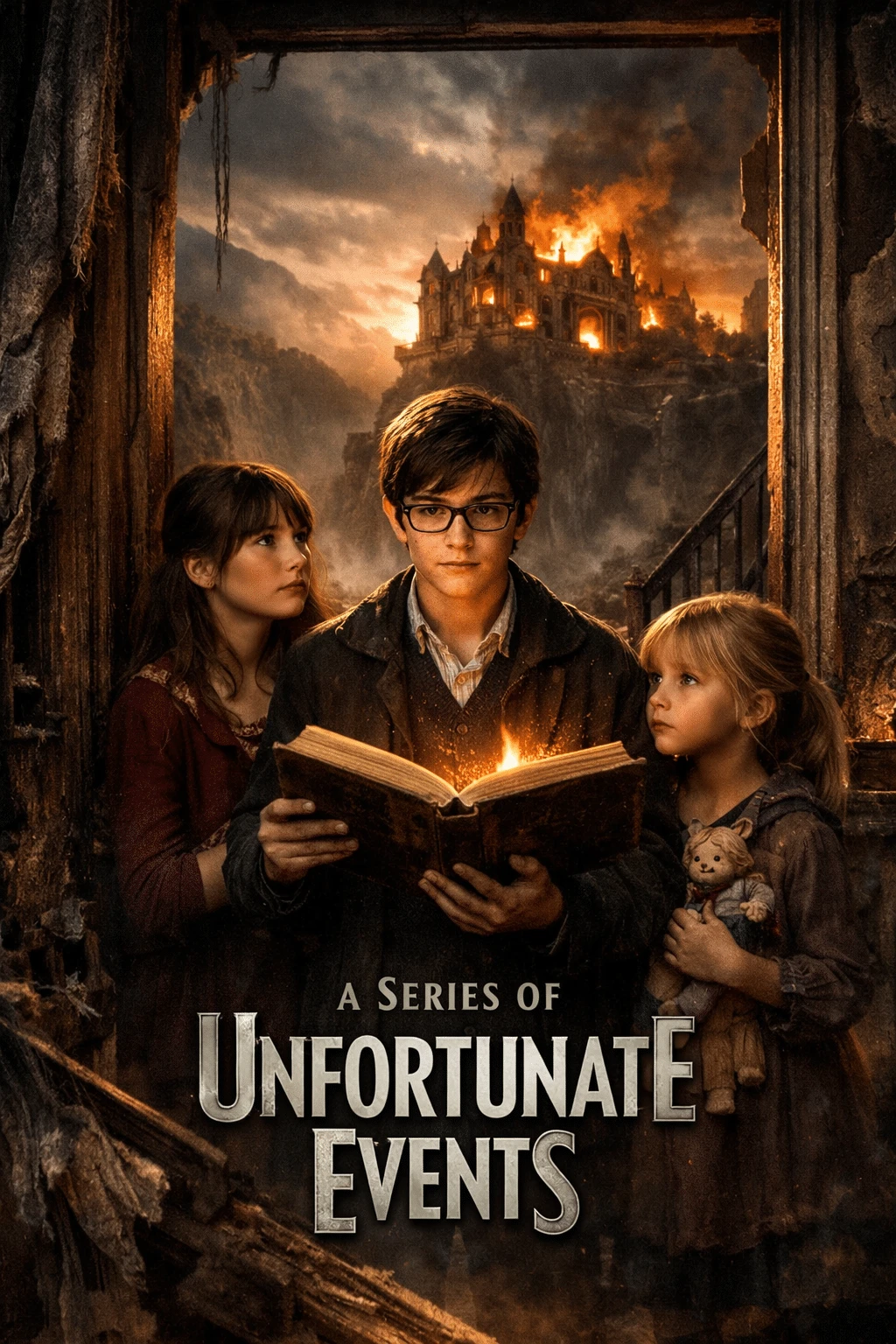
Hello, everyone! How’s it going? Today, I’m excited to share my thoughts on the series A Series of Unfortunate Events, which brilliantly adapted Lemony Snicket’s cherished book series into a visually captivating and emotionally rich portrayal that demonstrated children’s entertainment can be both sophisticated and truly engaging.
Advertisements
A Series of Unfortunate Events debuted on Netflix on January 13, 2017, showcasing 25 episodes over three seasons before wrapping up on January 1, 2019. Each episode lasts around 45-50 minutes, making it ideal for family watching and dark comedy marathons. This Netflix original follows the three Baudelaire orphans—Violet, Klaus, and Sunny—as they face a series of increasingly strange and perilous situations while being chased by the nefarious Count Olaf, who aims to seize their family fortune through elaborate schemes and disguises.
The series skillfully balances dark humor with authentic emotional resonance, crafting a viewing experience that treats young audiences with intelligence and respect. Unlike conventional children’s shows that gloss over tough subjects, A Series of Unfortunate Events delves into themes of loss, injustice, and moral ambiguity while maintaining a whimsical aesthetic that makes heavy topics accessible. The show’s distinctive narrative style, featuring Lemony Snicket as an unreliable narrator who speaks directly to the audience, creates an immersive storytelling experience that feels both theatrical and personal.
What sets this Netflix adaptation apart is its dedication to visual storytelling and atmospheric world-building that vividly brings Daniel Handler’s literary work to life. The series employs intricate production design, costumes, and cinematography to establish a timeless yet distinctly gothic ambiance that feels both nostalgic and modern. A Series of Unfortunate Events demonstrates that family programming can be artistically ambitious while remaining approachable to audiences of all ages.
The Baudelaire Orphans: Strength in the Face of Endless Misfortune
Malina Weissman, Louis Hynes, and Presley Smith deliver outstanding performances as Violet, Klaus, and Sunny Baudelaire, creating sibling dynamics that feel genuine and emotionally grounded despite their surreal circumstances. Throughout A Series of Unfortunate Events, the children’s unique abilities become their tools for survival: Violet’s ingenuity, Klaus’s vast knowledge, and Sunny’s sharp teeth combined with unexpected wisdom. Their character arcs illustrate how adversity can fortify family ties while uncovering internal strengths that might have remained hidden in ordinary situations.
The series excels in portraying how the orphans uphold their moral integrity and hope despite enduring repeated losses. Their steadfast loyalty to one another and commitment to uncovering the truth about their parents’ demise form the emotional core that makes viewers invested in their increasingly bizarre escapades.
Count Olaf: Neil Patrick Harris’s Masterclass in Theatrical Villainy
Neil Patrick Harris elevates Count Olaf from a mere antagonist to a multifaceted performer whose craving for recognition and validation fuels his villainous plots. Harris brings remarkable versatility to the role, effortlessly oscillating between comedic absurdity and genuine menace while retaining the character’s theatrical flair. A Series of Unfortunate Events utilizes Olaf’s various disguises and alter egos to examine themes of identity, performance, and the fine line between entertainment and manipulation.
The character acts as both the principal threat and a source of comic relief, creating a villain who is as ridiculous as he is genuinely menacing. Harris’s portrayal illustrates how the best children’s entertainment respects young audiences, trusting them to comprehend complex characters who can be both humorous and terrifying.
Lemony Snicket: Patrick Warburton’s Flawless Narrator
Patrick Warburton’s depiction of Lemony Snicket lends the series its distinctive narrative voice, functioning as both storyteller and character within the overarching mystery. His deadpan delivery and direct address to the audience create a theatrical quality that transforms A Series of Unfortunate Events into an experience akin to a live performance rather than conventional television. Snicket’s warnings about the unfortunate nature of the story introduce a playful tension that enhances rather than diminishes the suspense.
The character’s enigmatic connection to the Baudelaire family and the overarching conspiracy adds layers of intrigue that engage adult viewers while providing younger audiences with a reassuring presence that acknowledges their intelligence and emotional complexity.
When All Mysteries Unite
The series reaches its emotional and narrative climax in the final season as the orphans finally discover the truth about their parents’ demise and the secret organization V.F.D. A Series of Unfortunate Events delivers gratifying answers to long-standing enigmas while preserving the moral intricacies that have characterized the series throughout. The conclusion illustrates how the orphans’ experiences have equipped them to make difficult decisions regarding justice, forgiveness, and breaking cycles of violence.
Instead of providing simplistic resolutions, the finale explores how a deeper understanding of the past allows individuals to make wiser choices about the future, even when those choices involve accepting that some inquiries may never yield perfect answers.
Success on Netflix
A Series of Unfortunate Events emerged as both a critical and audience favorite during its three-season run from 2017 to 2019, receiving acclaim for its faithful adaptation of Daniel Handler’s cherished book series while expanding the source material in meaningful ways. The Netflix original demonstrated that family programming could be visually sophisticated and emotionally layered without sacrificing accessibility for younger viewers. Each episode was marked by intricate production design, costumes, and sets that established a distinctive gothic aesthetic, while the performances balanced humor and drama, appealing to both children and adults. A Series of Unfortunate Events exemplified how beloved literary works could be effectively adapted for streaming platforms, setting a high benchmark for children’s content that is both entertaining and artistically ambitious.
Essential Viewing for Families Who Value Thoughtful Entertainment
If you enjoy dark humor, gothic settings, and narratives that treat young audiences as capable of grappling with complex emotions and moral dilemmas, A Series of Unfortunate Events is an ideal series to binge on Netflix. The show succeeds because it never condescends to its viewers, instead crafting a viewing experience that becomes richer with each episode and rewards careful attention to detail.
Why This Adaptation Earns Literary Classic Recognition
A Series of Unfortunate Events demonstrates that the finest adaptations do not merely translate cherished books to the screen; they discover new ways to delve into the themes and characters that ensure the original work’s longevity. This Netflix series achieved something truly special by honoring Daniel Handler’s vision while leveraging the visual medium to amplify the story’s emotional impact, reminding viewers that the most unfortunate events often reveal our greatest strengths.
Series Information
Number of Episodes: 25 episodes (3 seasons, concluded series)
Platform: Netflix
Release/End Year: 2017-2019
Current IMDb Rating: 7.7/10
Genre: Dark Comedy, Family, Mystery, Adventure
Status: Completed series
Main Characters: Neil Patrick Harris (Count Olaf), Patrick Warburton (Lemony Snicket), Malina Weissman (Violet Baudelaire), Louis Hynes (Klaus Baudelaire), Presley Smith (Sunny Baudelaire), K. Todd Freeman (Arthur Poe)
Supporting Characters: Lucy Punch (Esmé Squalor), Dylan Kingwell (Duncan Quagmire), Avi Lake (Isadora Quagmire), various V.F.D. members and unfortunate guardians