
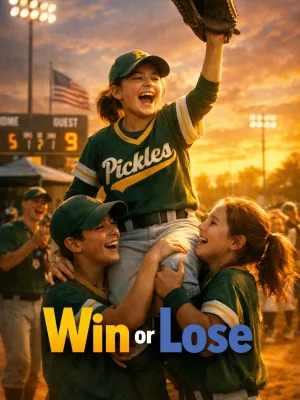
Hello, everyone! How’s everything? Today, I’m excited to share my thoughts on the drama Win or Lose, which marks Pixar Animation Studios’ inaugural long-format animated series, centering on a middle school softball team known as the Pickles during the week leading up to their championship match.
Advertisements
The eight-episode series debuted on Disney+ on February 19, 2025, with new episodes released weekly through March 12. Crafted and penned by Carrie Hobson and Michael Yates, each episode runs roughly 25-30 minutes and presents the same week from the viewpoint of different characters. Currently, the series boasts an impressive 89% rating on Rotten Tomatoes and an 8.0/10 score on IMDb, signifying a successful launch for Pixar as it ventures into serialized storytelling.
What sets Win or Lose apart is its distinctive approach to visual storytelling. Each episode provides insight into the off-field lives of the characters, showcasing their humorous, emotional, and universally relatable perspectives through a unique visual style that adapts to reflect their personalities and viewpoints. This innovative method highlights Pixar’s animation prowess while delving into the shared experience of adolescence through competitive sports.
Eight Perspectives, One Championship Week
The narrative follows a co-ed middle school softball team called the Pickles during the week leading up to their pivotal championship game, with each episode presenting the experience from the perspective of a different team member, each depicted in a unique visual style. Instead of spotlighting the entire ensemble at once, every episode focuses on a single character’s viewpoint, weaving a tapestry of interconnected narratives.
The brilliance of this storytelling format lies in its ability to show that individuals experience the same events in vastly different ways. What one character perceives as a trivial interaction can transform into a pivotal moment for another. While the championship game serves as the focal point, the authentic drama unfolds in the moments between practice and game day, encompassing family dinners, private conversations, and the quiet instances where these youngsters wrestle with identity, friendships, and the pressure to excel.
Each episode reveals further layers of the community surrounding the Pickles, illustrating how sports intersect with family dynamics, societal pressures, personal insecurities, and the intricate social hierarchies of middle school. This series illustrates that for these characters, softball transcends being just a game; it serves as a lens through which they interpret their entire existence.
Coach Dan and Adult Insights: Will Forte’s Grounded Leadership
Will Forte lends his voice to Coach Dan, delivering his trademark blend of sincerity and subtle humor to create a coach who truly cares about his players as individuals, not merely as athletes. Forte’s portrayal anchors the series in a relatable adult perspective without diminishing the young characters or the audience.
Coach Dan embodies the type of adult figure many of us desired during our own awkward middle school years. He faces his own personal hurdles while attempting to guide a group of kids through one of the most intense weeks of their young lives. Forte strikes a perfect balance between being an authority figure and a mentor, illustrating how the best coaches recognize that their responsibilities extend well beyond teaching proper batting techniques.
Episodes featuring adult viewpoints, including parents and other community members, enrich the children’s narratives. These characters are more than just obstacles or support systems; they are fully fleshed individuals with their own aspirations, fears, and connections to the game and their roles in these kids’ lives.
The Pickles Players: A Diverse Assembly of Genuine Voices
The youthful voice cast, featuring Milan Elizabeth Ray, Ian Chen, and others, injects remarkable authenticity into their roles. Each member of the Pickles possesses a distinct personality, family background, and connection to softball that feels nuanced rather than stereotypical.
Notably, the series addresses the diversity of its characters without making it feel superficial or forced. These are children from various backgrounds, family dynamics, and socioeconomic situations who unite through their shared passion for softball. Their interactions come across as natural and organic, authentically portraying how real middle schoolers navigate friendships, rivalries, and team dynamics.
The animation style adapts for each character’s episode, perfectly complementing the voice performances and creating a visual language that helps audiences grasp how each character interprets their surroundings. Some episodes are vibrant and full of energy, while others are more subdued and reflective, mirroring the inner lives of the characters whose viewpoints we are following.
Visual Innovation: Animation That Enhances Narrative
One of the standout achievements of Win or Lose is its innovative use of animation style as a storytelling tool. Every episode employs a unique visual strategy that mirrors the personality and emotional state of the perspective character. This is not merely a visual gimmick; it’s a sophisticated narrative approach that facilitates a deeper understanding of these characters.
Animation styles vary from frenetic and colorful to more restrained and realistic, with some episodes incorporating elements that feel almost dreamlike or surreal when characters confront particularly strong emotions. Pixar’s technical expertise shines through, yet it never overshadows the human stories at the core of the series.
This technique also enables the series to delve into themes and emotions that might be challenging to express through conventional animation methods. When a character feels overwhelmed, their surroundings may become chaotic and fragmented. Conversely, when they are focused and confident, everything might appear clearer and more vibrant.
Acclaim on Disney+
Win or Lose has garnered praise as a successful introduction for Pixar’s foray into serialized content, currently holding an 89% rating on Rotten Tomatoes. Critics have especially highlighted how the show respects its youthful viewers while crafting content that resonates with adults, a signature element of Pixar’s finest work.
The series has been described as charming yet occasionally flawed in some critiques, though the overall reception has been overwhelmingly positive. Disney+ subscribers have welcomed this inaugural original Pixar series, with many lauding its authentic depiction of middle school dynamics and family interactions. The weekly release schedule allows audiences to relish each character’s unique perspective while building excitement for the next episode.
Critics and viewers alike have remarked on how the series captures the intensity of middle school athletics while never losing sight of the fact that these are still children learning about themselves and their place in the world. It embodies the thoughtful, character-driven content that Disney+ was designed to showcase.
If you enjoy narratives about maturation, team dynamics, and how perspective shapes our understanding of reality, Win or Lose is a must-watch series to follow weekly on Disney+. It demonstrates that Pixar’s storytelling prowess translates beautifully to the small screen, providing the depth and emotional resonance we expect from the studio in a format that allows for even greater character development.
Tags: Pixar animation, middle school sports, coming of age, Disney+ original, perspective storytelling
Summary: A brilliantly crafted series that employs innovative animation techniques and multiple perspectives to deliver one of the most authentic and emotionally resonant portrayals of middle school life in recent memory.
Series Details:
Number of Episodes: 8
Platform: Disney+ (US) / Disney+ (International)
IMDb Rating: 8.0/10
Genre: Animated Comedy-Drama
Protagonists: Milan Elizabeth Ray (Rochelle), Will Forte (Coach Dan), Ian Chen, Josh Thomson
Antagonist: Personal insecurities and competitive pressure (internal conflicts)